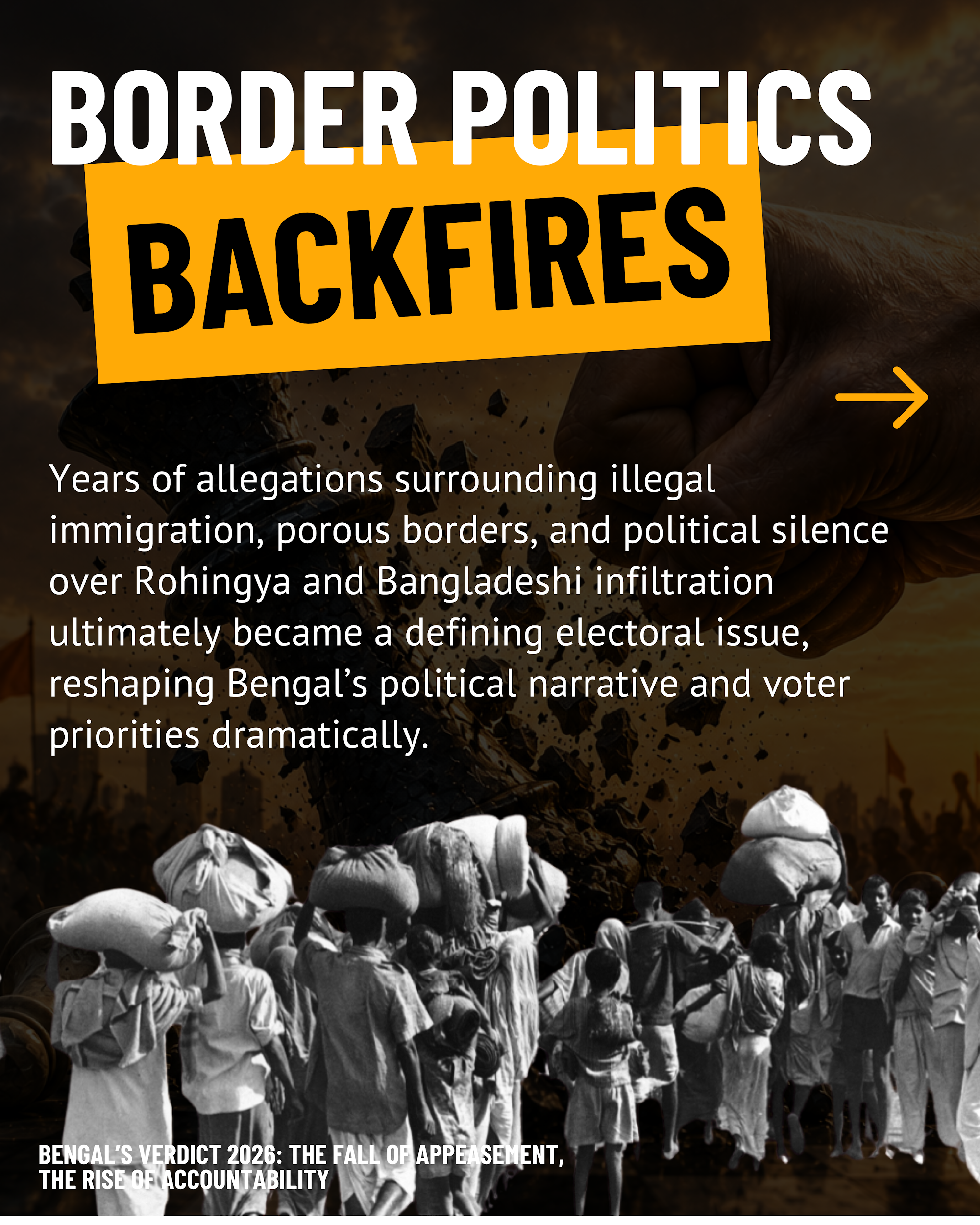
Being a border state adjacent to Bangladesh, West Bengal also carries immense strategic and security significance for the nation. The former state government has been seen to encourage illegal infiltration from Bangladesh for vote-bank politics and appeasement. Allegations surrounding porous borders, illegal immigration, and political silence over Rohingya and Bangladeshi infiltration eventually became defining electoral issues, reshaping Bengal’s political narrative and voter priorities. The matter emerged as a major national concern, with the Union Government often claiming difficulties in tackling the issue due to a lack of cooperation from the previous state administration. This is not only an important concern for the state of Bengal but for the entire country.
For years, West Bengal Chief Minister Mamata Banerjee and the Trinamool Congress faced sustained criticism from the Bharatiya Janata Party over allegations of encouraging appeasement politics and overlooking illegal immigration for electoral gains. The BJP repeatedly accused the state government of turning a blind eye to the infiltration of undocumented migrants, particularly from Bangladesh and among Rohingya settlements, arguing that the issue was not merely political but also deeply linked to national security and demographic stability. The concern resonated strongly in border districts where questions surrounding identity, citizenship, and resource distribution increasingly became part of public discourse. Critics alleged that illegal immigration was gradually altering the demographic character of certain regions and weakening the political voice of local residents and legitimate voters.
Over time, this narrative evolved beyond a conventional electoral accusation and became a wider debate around governance, border management, law enforcement, and the role of identity politics in Bengal’s political landscape. The opposition also consistently accused the Mamata Banerjee government of practising selective secularism and prioritising vote-bank considerations over balanced administration. Whether entirely perception or partially reality, these concerns gained political traction among a significant section of voters, eventually emerging as one of the defining themes of the 2026 Bengal Assembly elections.
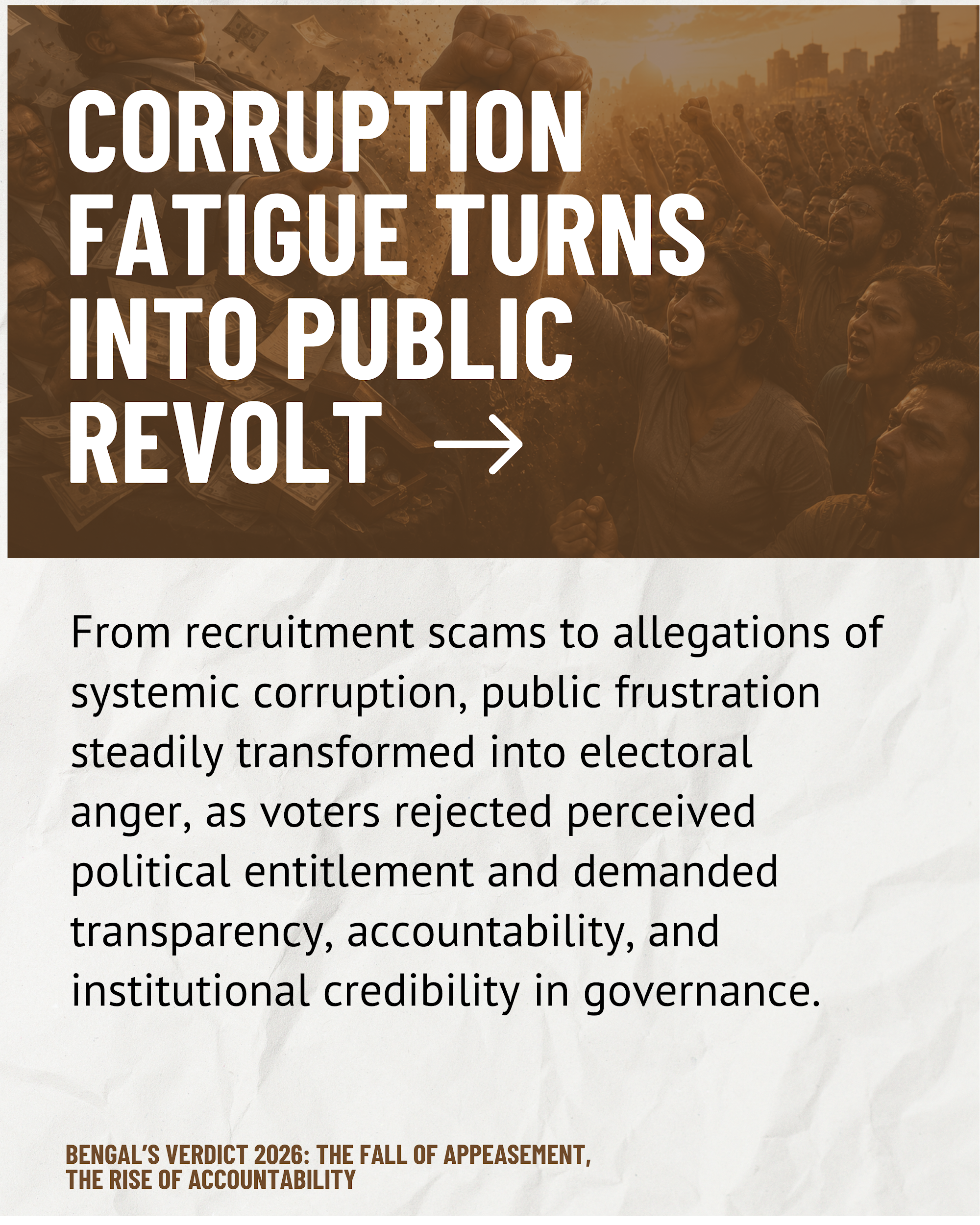
Apart from concerns surrounding border security, the Mamata Banerjee government has pending corruption allegations and lost its sense of accountability to the state. Her administration became associated with several major controversies, including alleged recruitment scams, coal smuggling investigations, and municipal recruitment irregularities. Investigative agencies such as the Enforcement Directorate (ED) carried out multiple probes involving individuals associated with the ruling establishment. These allegations significantly damaged the public perception of both Ms. Banerjee and her administration and contributed to the growing anti-incumbency sentiment. As we examine the very self of the TMC government it is well reflected how their loss is decide by their acts.
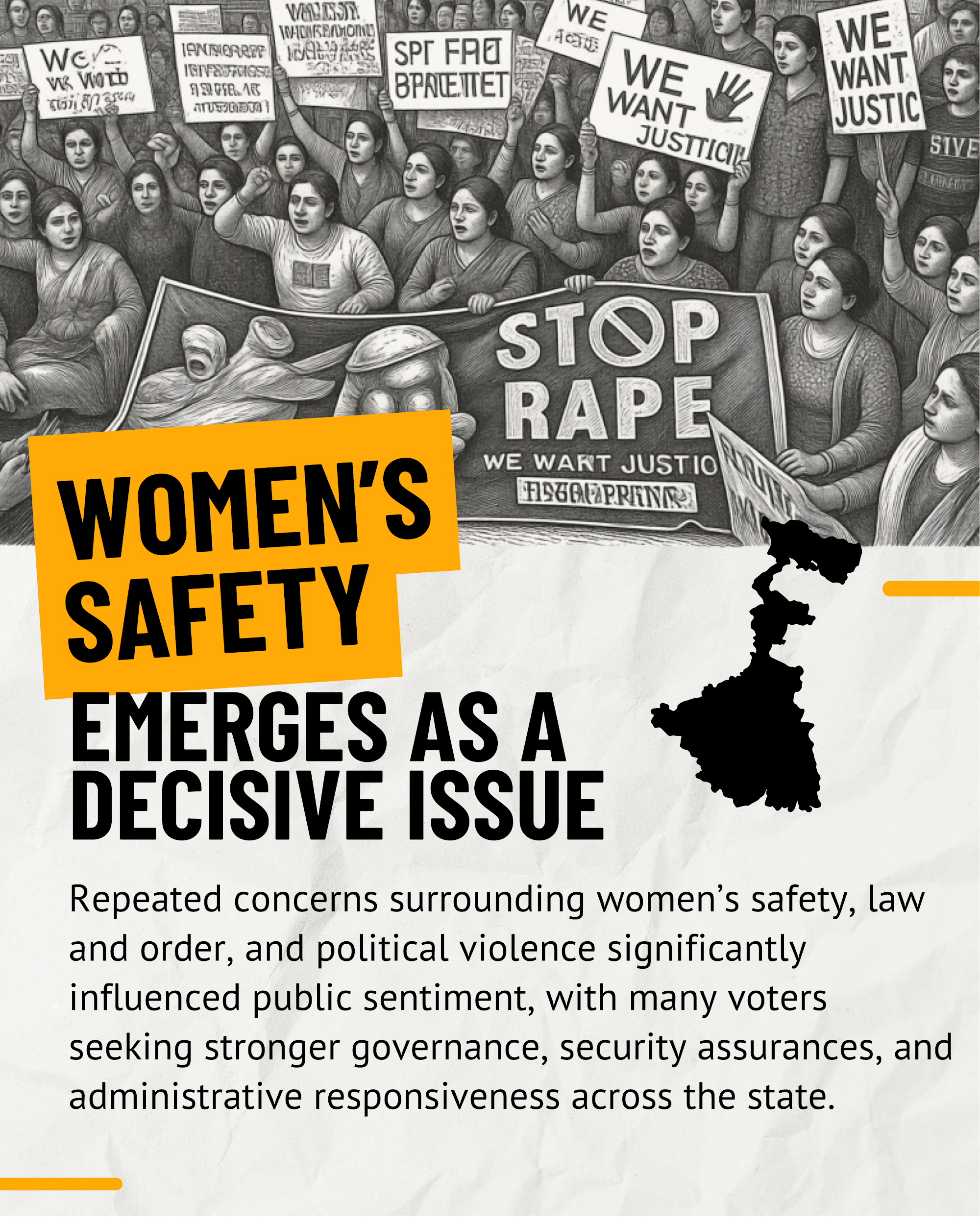
The final nail in the coffin was perhaps the growing public outrage over law and order, particularly regarding women’s safety. The rape and murder of a trainee doctor at Kolkata’s R.G. Kar Medical College on 9 August 2024 triggered massive protests and nationwide outrage. The case exposed serious concerns regarding institutional negligence and safety failures in public spaces and healthcare institutions. The matter was later transferred to the CBI, and the conviction of Sanjay Roy in early 2025 intensified the debate around governance and accountability. Mamata Banerjee also faced severe criticism for her reaction to the incident.
A large section of Bengal’s citizens appeared to vote with security, law and order, and women’s safety in mind. Many believed that the state government had failed in fulfilling those responsibilities, and they chose to express that dissatisfaction through the ballot box.
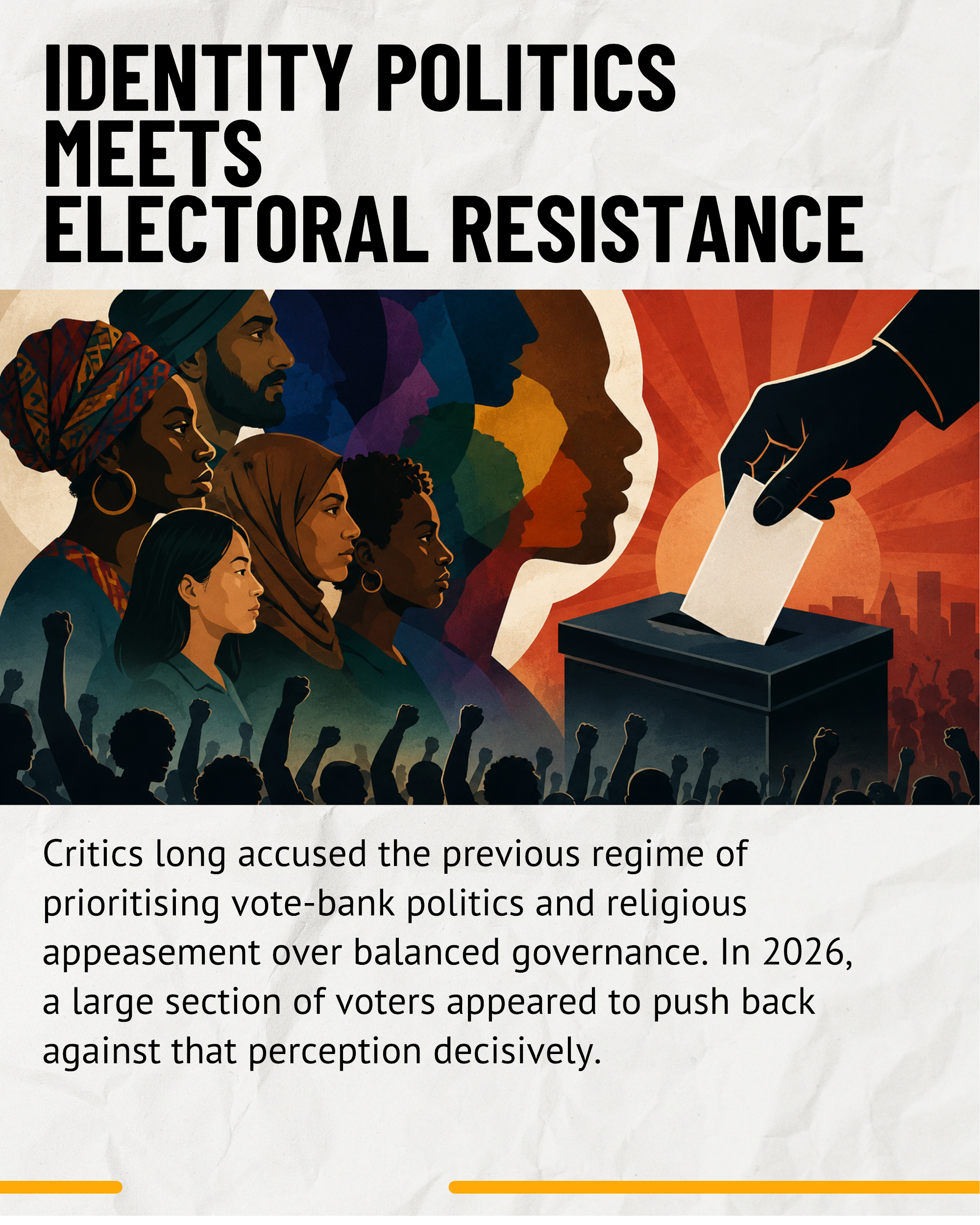
The former Bengal government has been seen for its selective appeasement politics. Mamata Banerjee’s administration has been favouring certain religious groups at the expense of balanced governance. Durga Puja, one of Bengal’s most significant cultural and religious festivals, became a recurring point of controversy during her tenure. In 2017, her government faced backlash and legal challenges over attempts to regulate Durga idol immersion timings due to Muharram processions. This is another example of vote-bank politics overriding cultural sensitivities and administrative neutrality. In 2026, a considerable section of voters appeared to push back strongly against that perception.
The BJP’s 2026 victory in West Bengal, securing more than 200 seats and breaking decades of regional political dominance, marks a historic ideological and political shift. A state once considered extremely difficult terrain for the BJP has now become central to the party’s larger “Purvodaya” vision — the rise of eastern India.
This victory significantly expands the BJP’s national footprint, weakens opposition momentum, and sets the stage for a new era of “double-engine” governance in Bengal. More importantly, it redraws the political map of eastern India and gives the BJP a substantial strategic advantage heading into future national elections.