The term Indo-Pacific was first coined by German geopolitician Karl Haushofer in the 1920s, but his interpretation differed from today's. He envisioned an Indo-Pacific region, encompassing Japan, China, and India—free from colonial rule—uniting with Germany to oppose the UK, the US, and Western Europe. The modern Indo-Pacific concept, first introduced in Shinzo Abe's 2007 'Confluence of the Two Seas' speech, describes a partnership between Japan, the U.S., and Australia to secure shipping routes and promote regional freedom and prosperity.
Assessing The Prospects for Great Power Competition in the Indo-Pacific
Today, the Indo-Pacific region accounts for over 60% of the world's GDP and population. The area further encounters security challenges, across disputes in the South China Sea, tensions on the Korean Peninsula and across the Taiwan Strait, and widening access to nuclear technology. The key forces are shaping a complex security environment characterised by both great power competition and growing interdependence.
Why the Indo-Pacific is the New Centre of Power
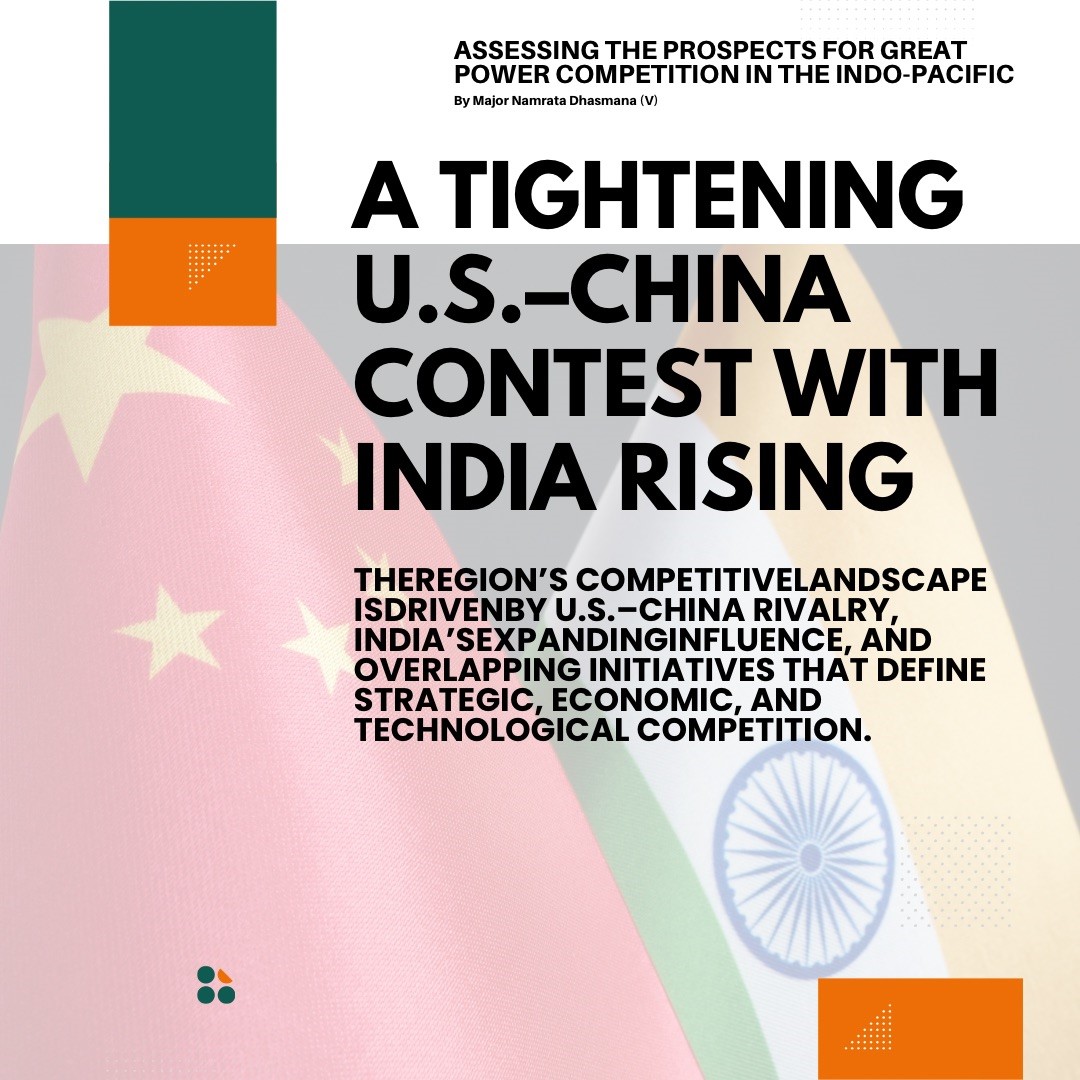
The Indo Pacific is not a fixed map- it’s a strategic geography. The abundance of natural resources and growing competition among major powers, such as the U.S. and China, are reshaping the geopolitical lan dscape. This shift prompts countries such as India, Japan, and Australia to forge strategic alliances to ensure regional stability.
Economically, it encompasses four of the world's largest economies (China, India, the United States, and Japan) and facilitates over 60% of international trade through vital maritime corridors, including the South China Sea and the Strait of Malacca. Strategically, it constitutes the nexus of US-China rivalry, with China's Belt and Road Initiative surpassing $1 trillion in investments, and India's emergence as a democratic power crucial to upholding a rules-based international order.
Assessing the Prospects for Great-Power Competition in the Indo-Pacific
The Indo-Pacific is the primary theatre of 21st-century power competition because:
1.China’s Rise vs. U.S. Dominance:
China seeks regional primacy and maritime access, and the U.S. aims to maintain the existing order. This creates continuous strategic friction.
2. Military Build-Up:
China’s military build-up is most visible in its navy's rapid expansion, now the largest with over 370 ships, including aircraft carriers, destroyers, submarines, and assault ships. China is restructuring forces for Indo-Pacific warfare and power projection. This surge, along with Beijing’s actions in the South China Sea and around Taiwan, prompts regional responses: India’s naval expansion, Japan’s rearmament, and U.S. force shifts to the Pacific. This intensifies military competition, shaping Indo-Pacific security.
3. Economic and Technological Rivalry:
Economic and technological competition is becoming the most decisive driver of Indo-Pacific geopolitics. The region hosts some of the world’s most critical semiconductor chokepoints — Taiwan, South Korea, and Japan — which together account for more than 70% of global semiconductor manufacturing and nearly 90% of advanced chip production. Control over this value chain influences global power. Meanwhile, nations such as Australia and Indonesia are emerging as vital suppliers of critical minerals like lithium, nickel, and rare earth elements — resources essential for defence systems, AI, and clean-energy technologies. Alongside these supply chains, a parallel contest is happening in digital infrastructure, from 5G ecosystems to submarine cables and AI platforms, with the U.S., China, and regional powers competing to dominate the next phase of connectivity. This economic–tech rivalry is no longer just about markets; it is about strategic leverage, security, and influence across the Indo-Pacific.
4. Flashpoints:
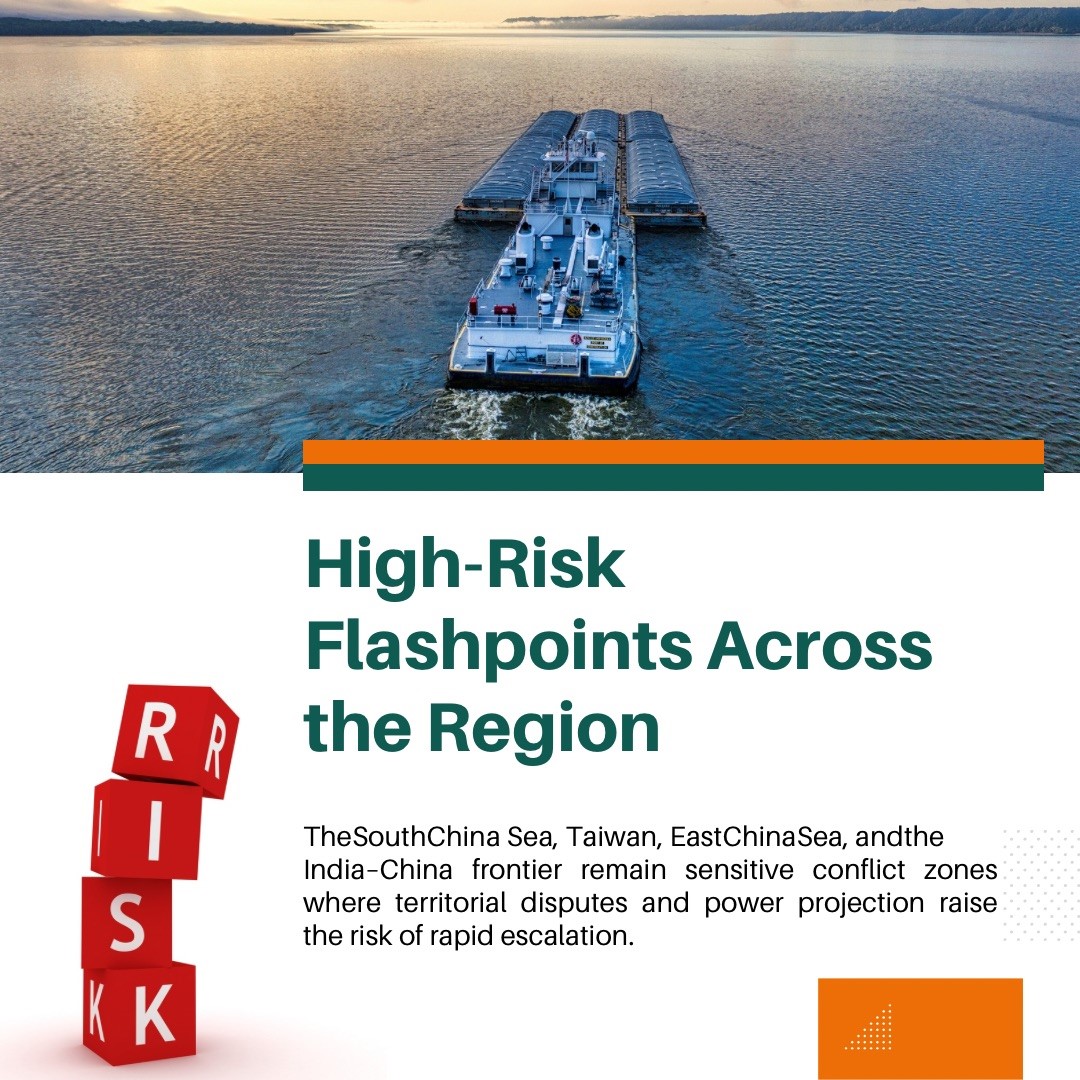
The Indo-Pacific is dotted with flashpoints where even a small incident can trigger rapid escalation among major powers. The South China Sea remains a maritime tinderbox, with overlapping territorial claims and militarised artificial islands increasing the risk of confrontation. The Taiwan Strait is the most volatile of these — any miscalculation around airspace or naval manoeuvres could draw in the U.S., Japan, and regional allies. Tensions also persist in the East China Sea, where China and Japan contest the Senkaku/Diaoyu Islands. On the continental front, the India–China border (LAC) continues to witness militarisation, infrastructure build-ups, and unpredictable standoffs, making it one of the world’s highest-risk land flashpoints. Each of these locations represents more than a bilateral dispute — they are intersections of national pride, military power, and great-power rivalry. Any escalation in one could reshape the strategic landscape of the entire Indo-Pacific.
5. Middle Powers Becoming Activists
India, Japan, Australia, Vietnam, and Indonesia are all shaping the region’s strategic architecture — not passive actors. The Indo-Pacific is a geopolitical arena defined by alliances, hedging, and rivalry — where the future of great-power competition will decide global power balances. China aims for regional dominance, and the U.S. seeks to maintain strategic order. India and middle powers work to preserve multipolarity.
Conclusion
The Indo-Pacific is entering a lengthy phase of strategic competition where no single nation will dominate. China’s fast military growth, economic assertiveness, and regional ambitions will continue challenging the U.S.-led framework, while the U.S. stays dedicated to preventing any one power from unilaterally shifting the balance. Rivalry in economy and technology—particularly over semiconductors, critical minerals, AI, and maritime supply routes—will grow as both nations seek structural advantages. Meanwhile, hotspots like the Taiwan Strait, South China Sea, East China Sea, and the India–China border will remain sensitive zones where misjudgments could escalate conflicts. The landscape is further complicated by rising middle powers—India, Japan, Australia, South Korea, Vietnam, and Gulf states—who are no longer passive but active influencers in regional developments. In this increasingly multipolar Indo-Pacific, competition will be ongoing, dynamic, and layered. Over the next decade, the main theme will not only be confrontation but an ongoing redefinition of power, influence, and security—shaped by nations aiming for independence, resilience, and strategic space in a region now central to global geopolitics.