Government Initiatives and Emerging Challenges
The Government of India has undertaken several strategic initiatives to modernise and strengthen the private security sector through regulatory reforms, structured training, and enhanced collaboration between public and private agencies.
At the centre of this framework is the Private Security Agencies (Regulation) Act (PSARA), which guides licensing, operational compliance,
and ethical practices. Complementing this, the Ministry of Skill Development and Entrepreneurship (MSDE)
is expanding specialised training programmes covering emergency response,
first aid, soft skills, cyber awareness, and conflict management.
To enhance national security preparedness, the government is promoting public–private partnerships, enabling shared training, operational cooperation,
and information exchange—particularly for critical infrastructure such as airports, ports, transportation hubs, and government establishments.
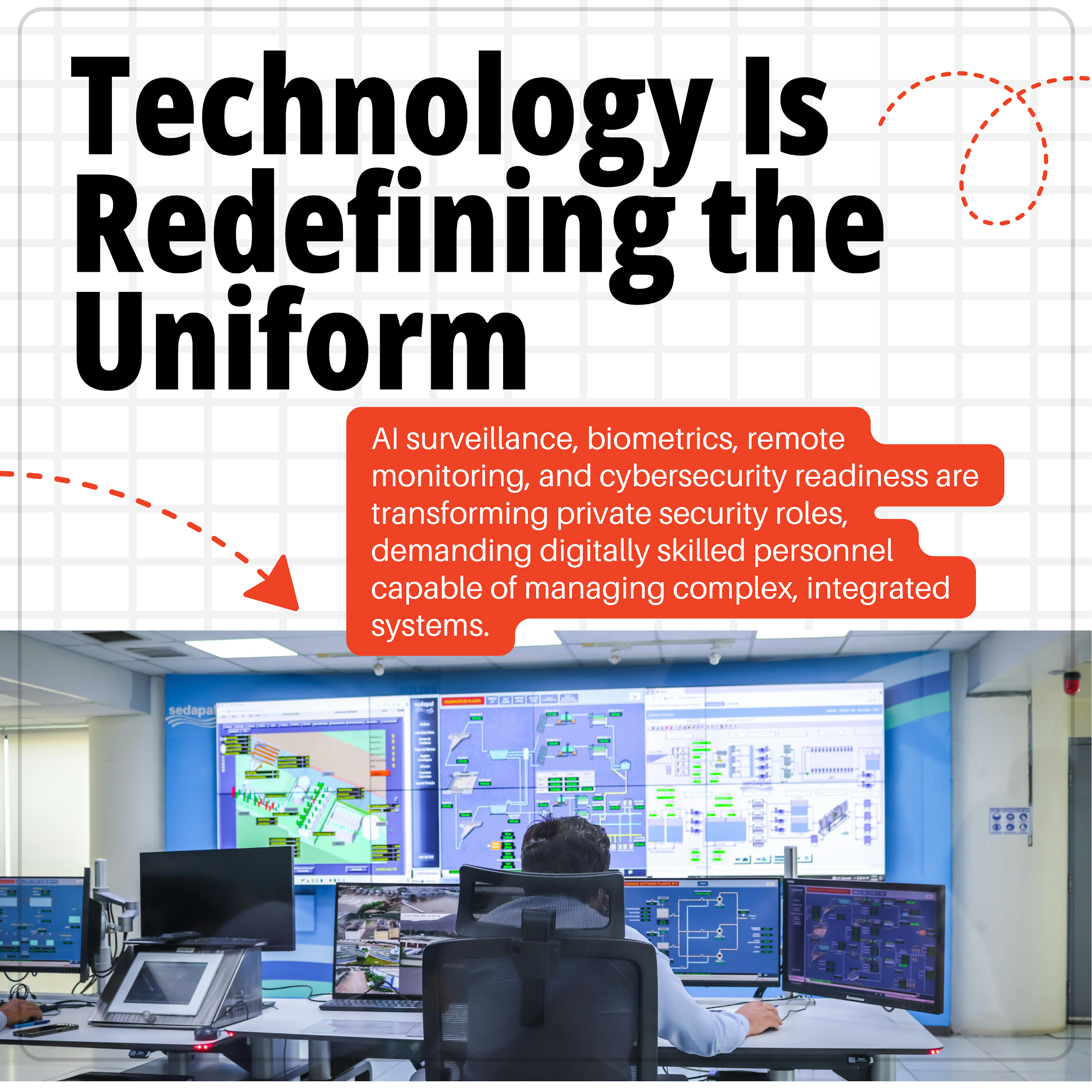
Agencies are also being encouraged to adopt AI-driven surveillance tools, biometric systems,
drone-based monitoring, and integrated command-and-control platforms to upgrade service delivery.
A major reform is the consolidation of India’s labour laws into four unified Labour Codes, effective from 21 November 2025.
These codes—covering wages, industrial relations, social security, and occupational safety—replace 29 outdated laws and establish a modern,
transparent, and industry-friendly labour framework. This transformation aims to boost compliance, improve worker welfare, and support a future-ready workforce,
directly benefiting the private security sector.
Integration with Civil Defence and Emergency Response Frameworks
Recognising the scale of India’s private security workforce—nearly one crore personnel, the largest uniformed force in the country—the Government is integrating PSI more closely with the national civil defence and emergency response ecosystem.
Key Initiative Include
- Pilot civil defence training programmes for private security trainers at no cost.
- The Civil Defence Warriors Digital Platform, enabling security guards to register voluntarily as certified responders and receive a unique ID number.
- Legal protection for registered responders under international humanitarian law during crises.
- Formal cooperation frameworks between civil defence agencies, home guards, and private security organisations for emergency response, community preparedness, and volunteer mobilisation.
- An upcoming collaboration with the National Disaster Management Authority (NDMA) to enhance coordinated disaster response.
These measures significantly improve India’s capacity to manage natural disasters, urban emergencies, and national contingencies with speed and precision.
Deployment of Indian Private Security Personnel Abroad
With global demand rising in sectors such as aviation security, critical infrastructure protection, hospitality, maritime services,
and executive protection, India has the potential to become a major global hub for trained private security manpower. Regions such as the Middle East, Europe, Africa,
and Southeast Asia are seeking skilled personnel, placing India in a favourable position due to its large workforce.
However, several gaps hinder overseas deployment:
- Absence of a national policy or framework for international placement.
- PSARA’s lack of provisions for international standards, licensing norms, and overseas compliance.
- Need for skills aligned with global requirements such as English proficiency, weapon-handling certification, and adherence to frameworks like the Montreux Document and ICoCA.
- Inconsistent visa categories and recognition of Indian qualifications abroad.
- Worker welfare risks—insurance gaps, high-risk postings, contract disputes, and weak grievance redressal.
A structured migration pathway, bilateral agreements, harmonised training standards, and stronger government oversight would not only expand global employment opportunities but also enhance India’s reputation as a reliable supplier of high-quality security professionals.
The Road Ahead: Toward a Viksit and Surakshit Bharat
As security threats grow more complex and interconnected, aligning India’s private security industry with global best practices is essential. The PSI must continue strengthening:
- Training standards
- Regulatory systems
- Technological integration
- International alignment
- Ethical governance
- Public–private partnerships
Lessons from international models—such as the Cybersecurity and Infrastructure Security Agency (CISA) of the United States for collaborative security
governance or General Data Protection Regulation (GDPR) of the European Union for data protection—offer insights
for developing India’s own hybrid security governance approach.
Aligned with India’s vision of Viksit Bharat 2047 and the complementary framework of Surakshit Bharat, the private security sector
is poised to evolve from a domestic support function into a globally competitive, technology-driven, and strategically relevant force.
With continued emphasis on human capital development, innovation, and regulatory coherence,
the PSI will play a vital role in strengthening national resilience and enhancing India’s global security footprint.